How did persuing a physics degree lead me to producing algorithmic fine art?
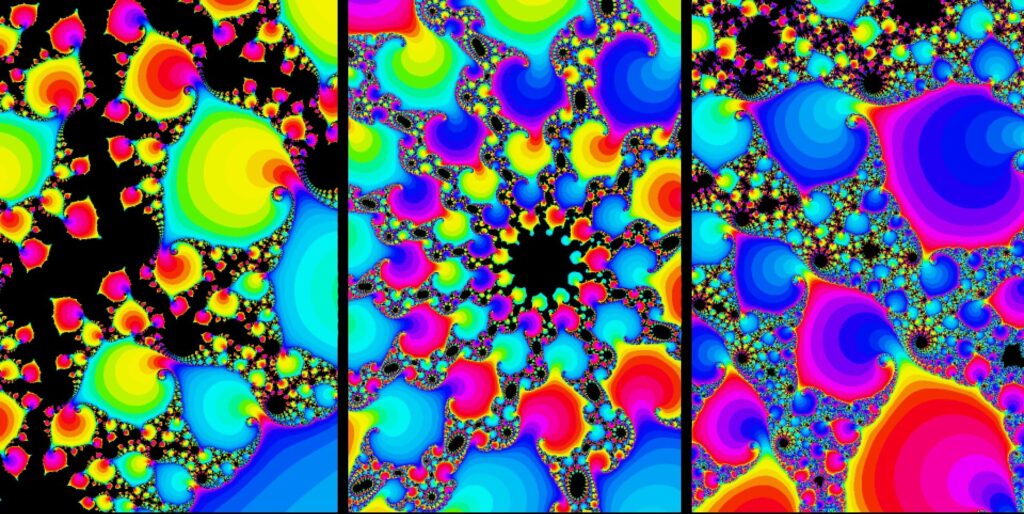
A few years ago, I became fascinated by fractals and even wrote an iPhone app to generate them. Although the results were beautiful and captivating, the Mandelbrot and Julia patterns my app produced weren’t truly “art” — they were mathematical artefacts. My only creative input was deciding how to colour them, while vaguely wondering how (or if) I could ever turn them into genuine artistic work.
Around this time, my painting practice — my real art — began to flourish. Meanwhile, the growing diversity of iPhones and iPads made it impossible to maintain my app, so I decided to remove it from the App Store.
In parallel, I’ve always been intrigued by physics, particularly astronomy, cosmology, and quantum theory, so I decided to pursue a BSc in Physical Sciences. That experience deepened my interest in mathematics, leading me to follow up with a master’s degree in the subject.
One of the attractions of the master’s course was a module on fractal geometry. Ironically, despite my earlier fascination with fractals, it failed to ignite any artistic inspiration — the focus was entirely on calculating fractal dimensions. (Conversely, the “Nonlinear Ordinary Differential Equations” module, which might sound dry, turned out to be far more visually stimulating.) In hindsight, perhaps I was a bit optimistic expecting artistic inspiration from a mathematics degree!
Then came the dissertation. Out of several possible topics, one jumped out at me: Aperiodic Tilings immediately stood out as the one with the most visual potential. I started writing code to generate examples of the tilings, experimenting with different ways of representing their patterns. That process became the seed of this new artistic direction I’m now exploring.
